Guide
Viking Range Warranty: Coverage and Genuine Parts
What a Viking range warranty usually covers, what voids it, genuine versus aftermarket parts, and how to find the right part number for your stove.
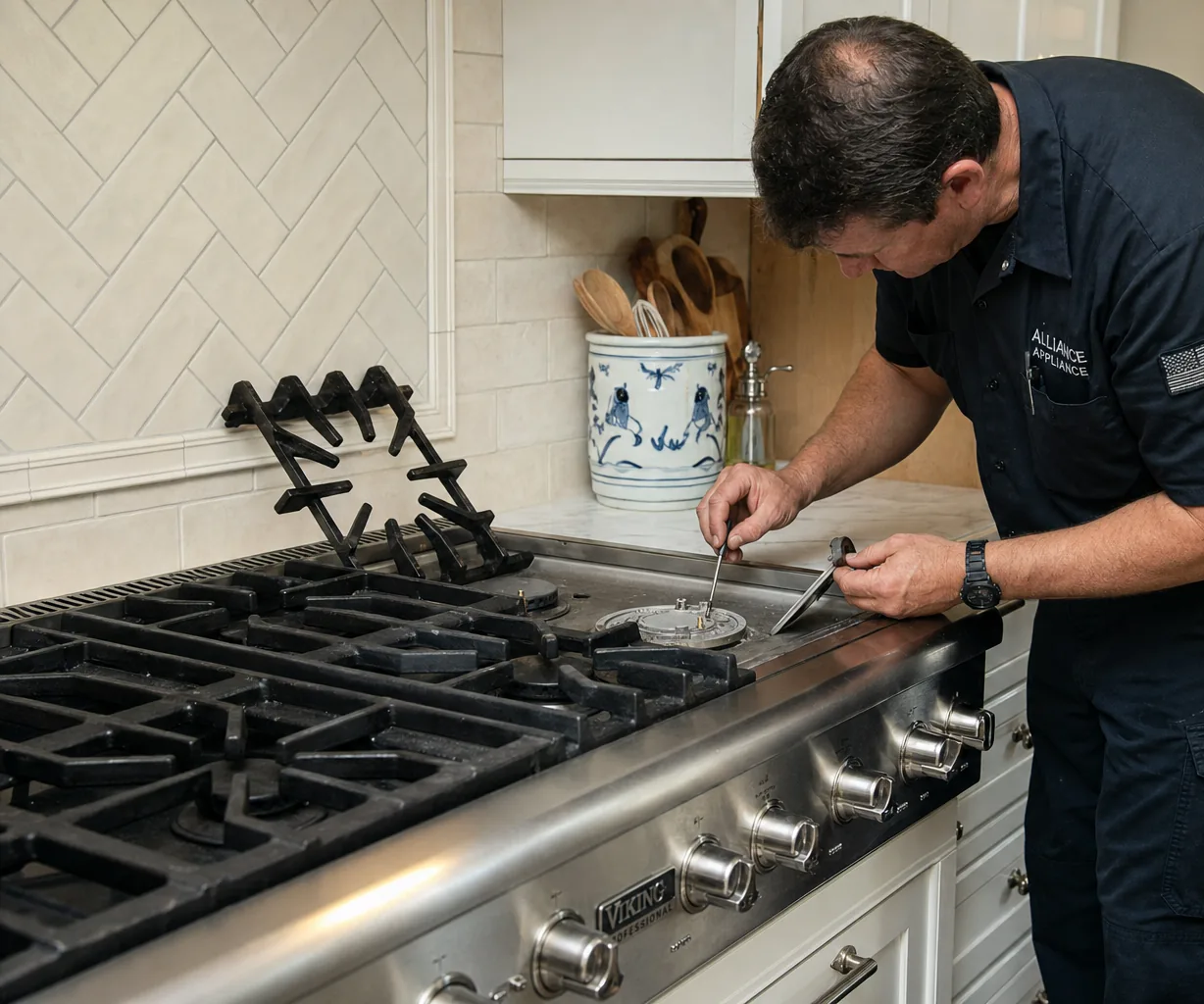
A Viking range warranty usually starts with a full parts-and-labor period on the whole range, then narrows to limited coverage on a few components, and it pays only for defects repaired through Viking’s own service network. Once that coverage ends, a range or oven repair typically runs $250–$900 and a diagnostic visit $95–$149, with the firm quote given on site after diagnosis.
The rest of this guide explains what decides whether a claim is accepted, when genuine parts matter, and how to read the exact part number off your stove before anything is ordered.
What does a Viking range warranty usually cover?
Premium range warranties, Viking’s included, are written in layers. In the first layer, a part that fails because of a defect in materials or workmanship is replaced, and the labor to install it is covered. In the later layers, coverage shrinks to named components, such as surface burners or the porcelain oven interior, and often to the part alone, so you may still pay for the visit and the labor.
How long each layer lasts depends on the product line and the purchase date, so the warranty card in your owner’s manual is the only reliable answer for your stove. Keep that card with the sales invoice and a note of the installation date; those three items settle most questions before a technician is ever booked.
The usual exclusions are cosmetic wear, heat discoloration, damage from harsh cleaners, broken glass or knobs from an impact, problems caused by the installation or the gas supply, and any non-residential use. A range that simply needs a burner cleaned or a tripped breaker reset is not a warranty failure either.
What can void or limit a Viking stove warranty?
Most refused claims come down to paperwork, installation or who did the work. The table shows the common situations.
| Situation | Effect on coverage | What to do |
|---|---|---|
| No proof of purchase or installation date | Claim may be delayed or refused | Find the invoice or the remodel contract |
| Gas range running on propane without the LP conversion | Resulting damage usually excluded | Have the conversion checked first |
| Repair by an outside servicer while still covered | That bill is not reimbursed | Call Viking before booking anyone |
| Aftermarket part fitted during coverage | Damage traced to that part may be excluded | Use genuine parts until coverage ends |
| Commercial or non-residential use | Typically not covered | Read the written terms |
| Range came with the house | Term still counts from the original purchase | Ask the seller for the paperwork |
That last row matters in Garden City. Many houses in the village are decades old even where the kitchen is new, and when one changes hands, a pro-style range built into the cabinetry almost always stays with it. The warranty clock started when the first owner bought or installed that range, not on your closing date, so ask the seller for the invoice before you assume anything is covered.
Genuine Viking parts or aftermarket: which should you use?
Genuine parts are built to Viking’s specification for your model; aftermarket parts are copies or universal designs meant to fit many brands. For trim pieces such as knobs, racks or grate feet, a well-made aftermarket part can be fine. For anything that controls gas, heat or ignition, stay with genuine parts.
The oven igniter shows why. On a gas oven, the glowing igniter does two jobs: it lights the burner, and its current draw opens the gas safety valve. A universal igniter that glows brightly but draws slightly less current may never open that valve, so the oven stays cold even though the new part looks like it is working. The same logic applies to burner valves, orifices, thermostats, temperature sensors and spark modules, where a small mismatch changes flame size, calibration or safety.
While the range is under warranty, use genuine parts only. Once coverage ends the choice is yours, but a cheaper part that has to be replaced twice is not a saving. Our Viking page covers the brand’s ranges, ovens and refrigeration in more detail.
How do you find the right part number for a Viking stove?
Getting a correct part number takes five steps and about ten minutes.
- Find the data plate. On most Viking ranges it sits behind the lower kick panel or under the front edge of the control panel; your owner’s manual shows the exact spot. Copy the full model and serial numbers, or photograph the plate.
- Note the fuel type and width. All-gas and dual fuel ranges share many cooktop parts but use different ovens, and 30-, 36-, 48- and 60-inch models use different grates, burners and panels.
- Open the parts diagram for that exact model. Each section of the range has its own exploded drawing with numbered callouts. The serial number matters because parts can change partway through a production run.
- Read the old part. Many igniters, valves and control boards carry a printed or stamped number. If the catalog lists a newer number that replaces yours, that supersession is normal.
- Match the details before ordering. Check the connector style, lead length, mounting holes and voltage. Electrical parts are often non-returnable once opened.
If the old part is burned or unreadable, the model and serial numbers are enough for a technician to identify it.
What does a Viking range repair cost after the warranty?
Out of warranty, you pay for the diagnosis, the part and the labor. These are typical ranges for common Viking range and cooktop work:
| Repair | Typical range |
|---|---|
| Diagnostic / service call | $95–$149 |
| Oven igniter or bake element | $250–$500 |
| Cooktop repair (burners, spark igniters, valves) | $200–$750 |
| Range / oven repair (controls, sensors, valves) | $250–$900 |
They are estimates, not quotes: the firm price is given on site after diagnosis, and the service call is credited toward the repair if you go ahead. See our range repair page for what a visit includes, and repair pricing for other appliances.
Garden City Viking Appliance Repair is an independent service, not manufacturer-authorized. While your range is still covered, start with Viking; once the warranty has run out, call (475) 268-8998 and we can diagnose it in Garden City, Mineola, Floral Park, Westbury and nearby towns.
Frequently asked questions
Does a Viking range warranty transfer when you buy a house?
It can carry over for whatever time remains, but confirm that on the written warranty card. Either way, the term counts from the original purchase or installation date, not from your closing date.
Will an aftermarket part void my Viking warranty?
Not automatically, but damage caused by a non-genuine part is usually excluded from coverage. While the range is covered, genuine parts installed through Viking’s service network are the safe choice.
Where is the serial number on a Viking stove?
On most models it is on a data plate behind the lower kick panel or under the front edge of the control panel. The owner’s manual for your model shows the exact location.
How much does a Viking range repair cost out of warranty?
A typical range or oven repair runs $250–$900, and an oven igniter or bake element $250–$500. The firm quote is given on site after diagnosis.